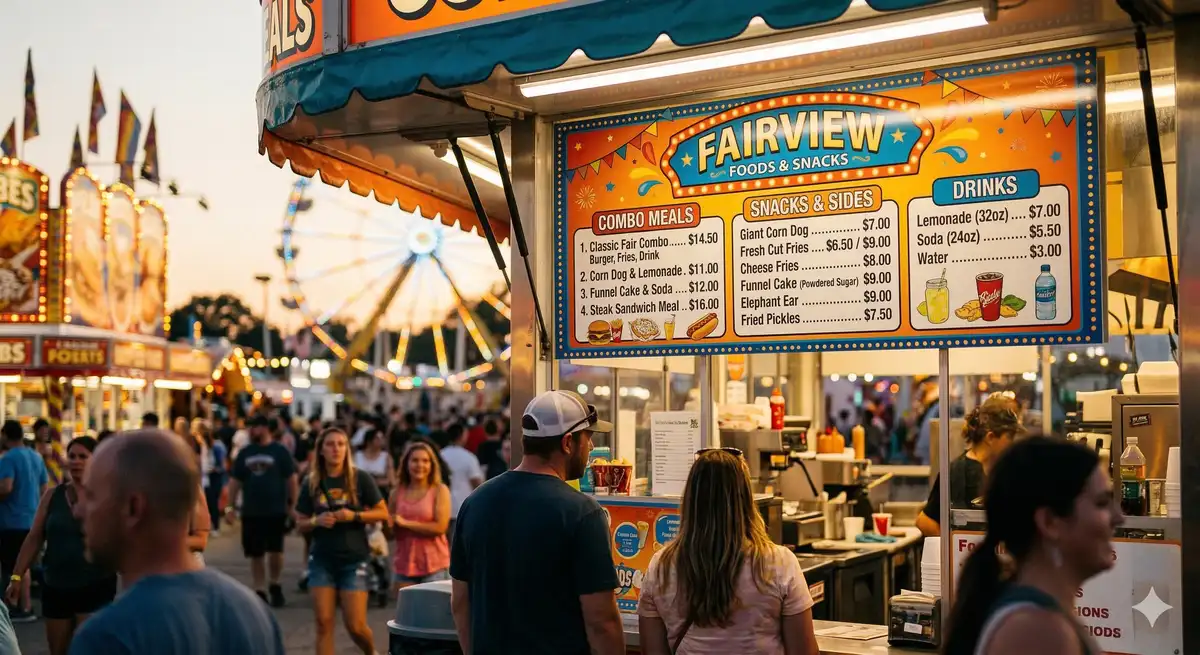
Most concession operators price their menu by gut feeling — they look at what competitors charge and either match it or go a little lower. That's a losing strategy. If you don't know your actual food cost, your labor, and your overhead per event, you're guessing. And guessing at a state fair with $10,000 in expenses on the line is not a game you want to play.
This guide will walk you through how to price your concession menu the right way — with real numbers, real formulas, and the mindset shift that separates profitable operators from ones who work hard and break even. If you're still in the planning stage, start with our how to start a concession stand guide to get the foundation right first.
Why Most Concession Operators Underprice Their Menu
Most new vendors price based on fear. They're afraid to charge too much, so they price low to attract customers. The problem is that concession events have a ceiling on how many customers you can serve — limited by foot traffic, booth size, and staff. Price too low and you cannot make it up in volume.
The second mistake is copying competitors without knowing their cost structure. A vendor who's been at the same fair for 15 years has paid off their trailer and has buying power with suppliers. Their pricing reflects their cost structure — not yours.
Price your menu based on your costs. Full stop.
The Food Cost Formula Every Vendor Needs to Know
Food cost percentage is the foundation of menu pricing. Here's the formula:
Food Cost % = (Cost of Ingredients / Menu Price) x 100
For concession stands, your target food cost should be between 25% and 35%. If your ingredients cost $1.50 and you want a 30% food cost:
Menu Price = $1.50 / 0.30 = $5.00
General targets by food type:
- Fried foods: 20–28%
- Proteins: 28–35%
- Beverages: 15–22%
- Combo meals: 25–32%
Beverages are your highest margin item. If you're not selling a drink with every order, you're leaving serious money on the table.
Stop guessing — run your real numbers right now
Use our free calculator to find your exact menu price, check your food cost %, and forecast your event profit.
🧮 Open the Free Pricing Calculator →How to Calculate Your True Cost Per Serving
True cost per serving includes more than just the main ingredient. You need to account for:
- Primary ingredients
- Packaging (trays, cups, napkins)
- Condiments and extras
- Waste factor (add 5–10% for spoilage)
Example — pulled pork sandwich:
- Pork (4 oz cooked): $1.20
- Bun: $0.25
- Coleslaw: $0.18
- Sauce: $0.08
- Tray and napkin: $0.14
- Waste factor (8%): $0.15
- Total true cost: $2.00
At a 30% food cost target: $2.00 / 0.30 = $6.67 — round up to $7.00. That's your minimum profitable price.
How to Design a Concession Stand Menu Board That Sells
Your concession stand menu board is doing selling work while you're cooking. Most operators treat it as an afterthought. The ones making the most money treat it as a sales tool.
A high-converting menu board follows a few simple rules. Use large text readable from at least 10 feet away. Put your highest-margin item at the top in the largest font — people order what they see first. List prices clearly but don't make them the focal point. Use photos if you can, because people buy with their eyes. Keep it to six items maximum — more than that creates decision paralysis and slows your line.
Digital menu boards have dropped in price and are worth considering if you're doing serious volume. They let you adjust pricing by event and push featured items. A clean static board on coroplast or aluminum is completely fine for most operators starting out — just design it intentionally, not as an afterthought.
One more thing: "best selling concession stand items" isn't universal. It depends on your concept, your event type, and your region. The menu board should reflect what moves fastest for your operation at your events — not a generic list from the internet.
Event Type Changes Everything
A state fair and a small-town festival are completely different pricing environments. At a state fair, customers expect to spend more. At a local farmers market, the same product might need to be priced 20–30% lower.
Before setting prices, ask:
- What is the average entry fee?
- What are other vendors charging?
- What is the demographic?
- Is it a multi-day event?
At my state fair booths I price at the top of the range. When starting out, price at mid-range and move up as you build a reputation.
The Anchor Price Strategy
Put your largest, most expensive item at the top of your menu board — everything else looks reasonable by comparison.
Example:
- Family Pack (feeds 4): $28
- Large Combo: $14
- Regular Combo: $10
- Kids Meal: $7
The $28 Family Pack is your anchor. Most people won't buy it — but it makes the $14 combo feel like a smart choice.
Also bundle everything. Sandwich plus side plus drink for $12 outperforms selling each item separately — even when the math is identical.
Adjusting Prices Mid-Season
Review your food cost every 2–3 months because ingredient costs change. Rules for price changes:
- Never lower prices during an event.
- If you must raise prices, do it between events — not mid-fair.
- Update menu board graphics before the event.
- Small incremental increases ($1 at a time) are less noticeable than one big jump.
Customers care about value, not price. If your product is good, a $1–2 price increase will not hurt sales.
The Menu Size Problem
More items does not mean more revenue. It means more complexity, more waste, and slower service. Keep your menu tight:
- 3–5 core items maximum
- Each item should share ingredients where possible
- Your highest-margin item should be your signature
- Remove anything that sells fewer than 10 units per day
Every item you add increases prep time and waste. Every item you remove makes your operation faster and more profitable.
The Bottom Line on Concession Pricing
Profitable concession pricing comes down to three things: know your costs, price above them with a healthy margin, and position your menu to guide customers toward your best items.
Stop guessing, stop copying competitors, and stop being afraid to charge what your product is worth.
If you want to go deeper on building a full pricing spreadsheet, calculating your break-even per event, and structuring your menu for maximum average ticket — this is exactly what we cover in The Roadmap. Understanding your concession stand startup costs is the first step, and smart pricing is what turns those costs into profit.
Join The Concession Collective free and get access to our community of operators running profitable booths across the country.
For operators serious about accelerating their growth, learn about our Inner Circle program — our highest-tier coaching with only 5 spots. And if you're comparing options, read our food truck vs concession trailer vs food booth breakdown to pick the right format for your concept.
Launching in a specific state? Browse our state-by-state food truck guides for local licensing, events, and costs.