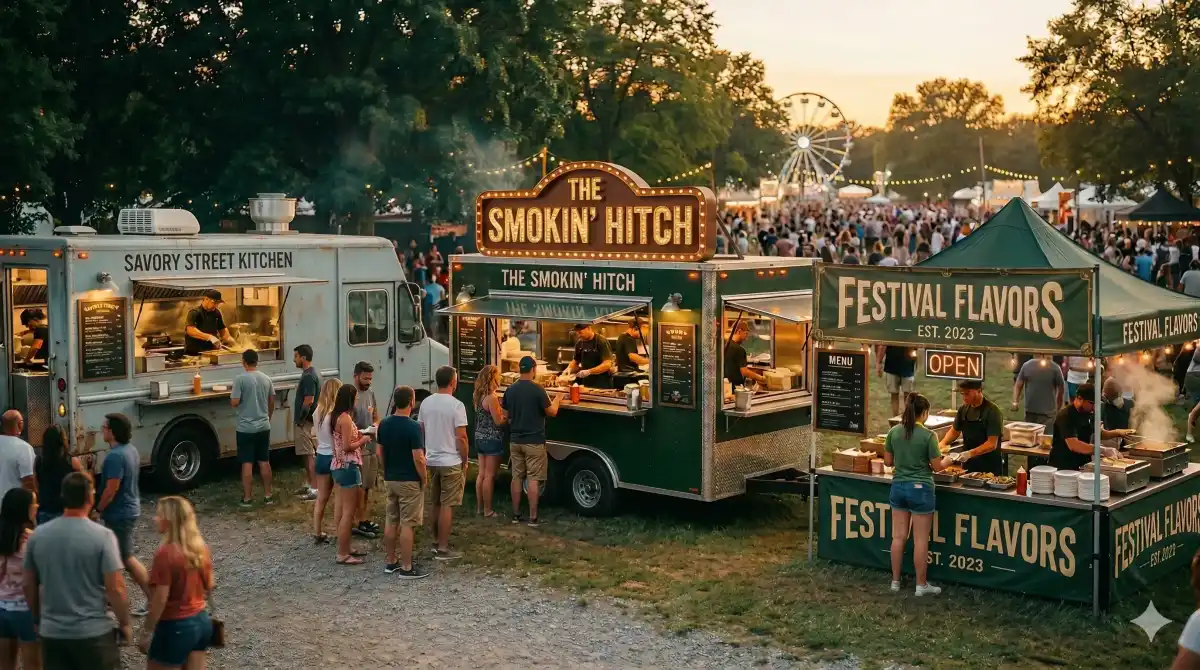
I've operated all three formats. Food trucks, concession trailers, and booths at state fairs across five states. I've made money with all of them and lost money trying to force the wrong format into the wrong situation.
This guide will save you that mistake.
The format you choose determines your startup costs, your flexibility, your event options, and your profit potential. Getting it wrong costs you time and money you can't get back. Getting it right gives you a competitive advantage from day one.
If you want to talk through which format fits your specific situation, join The Concession Collective for free — I answer these questions in the community every week.
What Is a Food Truck?
A food truck is a self-contained mobile kitchen built inside a vehicle — typically a step van, box truck, or converted bus. The kitchen equipment is permanently installed inside the vehicle. You drive it to locations, plug in or run on generator power, and operate from inside the vehicle.
Typical startup cost: $40,000 — $150,000+
Best for:
- Urban street food markets
- Fixed weekly locations (brewery partnerships, office parks, college campuses)
- Cities with established food truck culture
- Operators who want to move frequently between locations
Biggest advantages:
- Self-contained — no tow vehicle needed
- Easier parking in urban environments
- Strong brand visibility as a moving billboard
- Faster setup at locations with established infrastructure
Biggest disadvantages:
- Highest startup cost of the three formats
- Expensive to repair and maintain (vehicle + kitchen)
- Limited interior space compared to a trailer
- Harder to customize or expand once built
What Is a Concession Trailer?
A concession trailer is a mobile concession stand on wheels — a fully equipped kitchen towed behind a pickup truck or SUV. The trailer stays parked at events while the tow vehicle is free to leave. Trailers range from small 8-foot units to large 24-foot custom builds with multiple cooking stations.
Typical startup cost: $15,000 — $80,000
Best for:
- Fairs, festivals, and events
- Operators who want more kitchen space
- Concepts that require heavy equipment
- Operators running multiple events simultaneously (trailer stays, truck leaves)
Biggest advantages:
- More kitchen space per dollar than a food truck
- Easier and cheaper to customize and modify
- Tow vehicle is separate — lower overall maintenance cost
- Easier to scale (add a second trailer for less than a second truck)
- Better stability at long events
Biggest disadvantages:
- Need a capable tow vehicle (additional cost)
- Harder to maneuver in tight urban spaces
- Less visibility as a brand on the road
- Requires level ground and proper hookups at events
What Is a Food Booth?
A food booth is a portable concession stand — a tent-based or semi-permanent structure set up at events. There is no vehicle — you transport equipment in a pickup truck or van and set up on-site. Booths are most common at fairs, festivals, farmers markets, and outdoor events.
Typical startup cost: $5,000 — $25,000
Best for:
- State fairs and large festivals
- Operators starting with limited capital
- Testing a concept before investing in a vehicle
- High-volume, simple-menu operations
Biggest advantages:
- Lowest startup cost of the three formats
- Maximum flexibility — the footprint can be large or small
- Easier to get into state fairs and large events (many require booth format)
- Can operate multiple booths at the same event with one team
- Easier to modify your setup each season
Biggest disadvantages:
- Setup and teardown is labor intensive
- No weather protection beyond your tent
- Equipment must be transported and set up every event
- Less brand presence than a vehicle
Side-by-Side Comparison
Here is a direct comparison across the factors that matter most:
| Factor | Food Truck | Concession Trailer | Food Booth |
|---|---|---|---|
| Startup Cost | $40K-$150K+ | $15K-$80K | $5K-$25K |
| Kitchen Space | Limited | Most flexible | Variable |
| Mobility | Drive anywhere | Tow required | Transport + setup |
| Urban use | Best | Difficult | Possible |
| Fair/festival use | Good | Excellent | Excellent |
| Maintenance cost | Highest | Medium | Lowest |
| Customization | Difficult | Easy | Most flexible |
| Brand visibility | Highest | Medium | Low |
| Scaling cost | High | Medium | Lowest |
Which Format Makes the Most Money?
This is the wrong question. The right question is: which format makes the most money for your specific concept at your specific events?
Here is how to think about it:
If you are targeting urban street food markets and regular weekly locations — food truck. The mobility and self-contained nature of a truck is built for city environments. A trailer is a liability in tight urban spaces.
If you are targeting fairs, festivals, and events — concession trailer or booth. Trailers give you the most kitchen space and flexibility. Booths give you the lowest entry cost and the best access to large state fair footprints.
If you are just starting out with limited capital — booth. Build your concept, prove your numbers, develop your team and systems. Then invest in a trailer or truck when you have proven revenue and know exactly what you need. For a step-by-step guide to the booth path, read our how to start a concession stand guide.
If you want to scale to multiple units — trailer or booth. Adding a second trailer costs $15,000-40,000. Adding a second truck costs $40,000-150,000. The math favors trailers and booths for multi-unit operators.
The Format I Use and Why
I run 12 food concepts across 5 state fairs. Most of them are booth-based operations with some trailer units. Here is why:
State fairs require large footprints — a single booth space can be 20x20 feet or larger. A food truck cannot fill that space the way a custom booth setup can. The fairs I work have also historically preferred booth operators because they fit the event layout better than vehicles.
My trailer units are used for events where I need a full commercial kitchen on-site with reliable power and water hookups. The trailer stays, the truck leaves, and I can run multiple events simultaneously.
I have never operated a food truck. Not because they are a bad business — they are not — but because my market is state fairs and festivals, and trailers and booths serve that market better.
Your market should drive your format decision. Not the other way around.
How to Choose the Right Format
Answer these four questions honestly:
1. Where will you operate?
Urban street locations → food truck
Fairs, festivals, events → trailer or booth
2. What is your startup budget?
Under $15,000 → booth only
$15,000-40,000 → trailer or booth
$40,000+ → all three are options
3. How complex is your menu?
Simple, high-volume menu → booth
Full commercial kitchen needed → trailer
Complex menu in urban setting → truck
4. Do you want to scale?
Single unit, urban → truck
Multiple units, events → trailers and booths
If you answer these honestly, the right format usually becomes obvious.
Common Mistakes to Avoid
Buying a food truck because it looks cool. Food trucks are the most visible format which makes them aspirational. But visibility is not a business model. Buy the format that fits your market, not the one that gets likes on Instagram.
Starting with a trailer when your market is urban. If you are targeting city streets, a trailer is a liability. They are hard to park, hard to maneuver, and not built for the quick location changes urban food service requires.
Underestimating booth labor. Booth setup and teardown is physical, time-consuming work. If you are doing 30 events a season solo, the labor will wear you down. Build your team before you scale your event count.
Buying used without a proper inspection. Used trucks and trailers can be great value — or they can be money pits. Always have a mechanic inspect any used vehicle before purchase. Check the generator, propane systems, refrigeration, and hood suppression system specifically.
The Real Starting Point
The format is secondary to the concept and the market. Figure out what you are selling, who is buying it, and where those buyers gather. Then choose the format that gets you in front of them most efficiently.
If you are still working through these decisions, The Concession Collective is where I and other active operators answer exactly these kinds of questions. It is free to join and the community includes people who have made every format work in every kind of market.
For a complete breakdown of what it costs to start in any format, read our guide on concession stand startup costs. If you're considering a tent-based setup, shaved ice is one of the best concepts for the booth format — low equipment needs, high margins, and minimal startup cost.
For help pricing your menu once you have chosen a format, use our free concession stand pricing calculator.
To understand which programs can help you build your operation faster, compare all our coaching plans here.
For operators serious about accelerating their growth, learn about our Inner Circle program — our highest-tier coaching with only 5 spots.