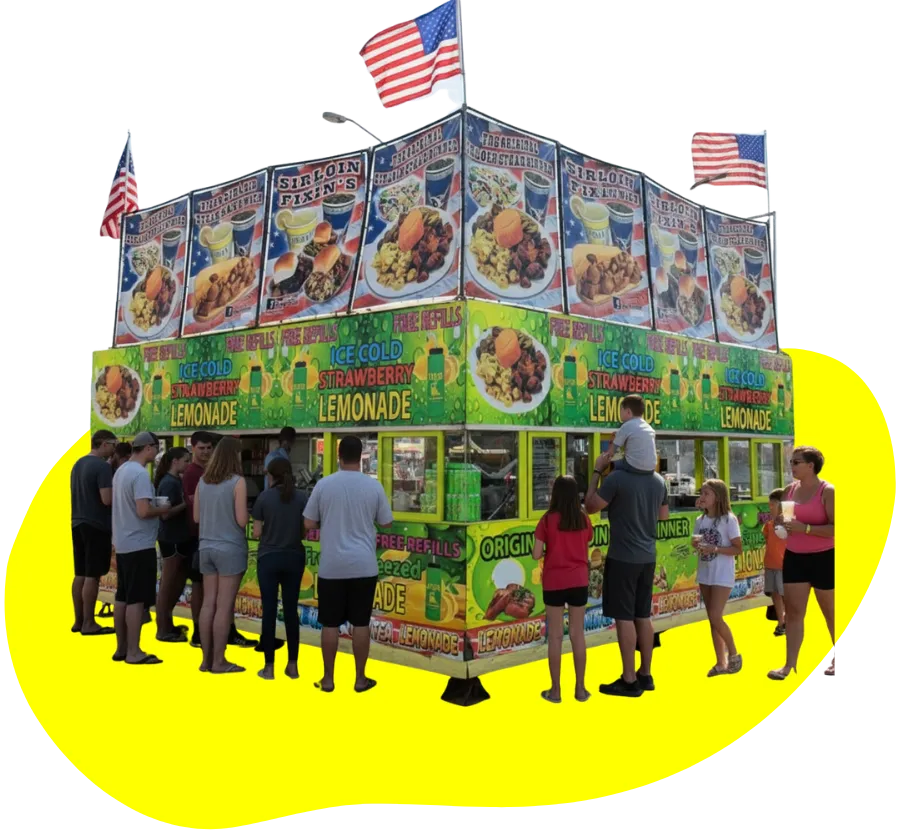
I have operated at 5 state fairs across 9 states with 12 food concepts. I know what the committees look at, what gets applications rejected, and what gives you the best chance of getting in. This guide covers all of it.
Getting approved for a state fair is not just about having good food. It is about presenting yourself as a professional operation that the fair can trust to show up, perform, and represent their event well.
If you are already in the application process and want guidance from operators who have been through it, join The Concession Collective for free — we discuss fair applications and strategy every week.
How State Fair Vendor Selection Actually Works
Most first-time applicants assume fairs pick vendors based on food quality alone. That is not how it works.
State fairs select vendors based on a combination of:
Menu diversity — fairs want a balanced selection of food types. If they already have three burger vendors, a fourth application for burgers goes to the bottom of the pile regardless of how good your burgers are. Know what is already at the fair before you apply.
Operational reliability — fairs have been burned by vendors who do not show up, shut down mid-event, or cannot handle volume. Your application needs to demonstrate that you are a real, established operation.
Financial stability — booth fees at major state fairs can run $5,000-$30,000 or more for the run. Fairs want vendors who can pay and who will not disappear when things get hard.
Presentation and professionalism — your booth setup, signage, uniforms, and overall presentation reflect on the fair. Committee members evaluate this seriously.
Relationships — this is the part nobody talks about. Fairs are relationship businesses. Vendors who have operated at other fairs, who know people in the industry, and who have references get preferential consideration.
Step 1 — Research the Fair Before You Apply
Before you submit a single application, spend time understanding the fair you are targeting.
Visit the fair as a customer. Walk every food vendor aisle. Document what concepts are already there. Identify gaps — what food types are missing or underrepresented? That gap is your opportunity.
Study the vendor map from previous years. Most fairs publish their vendor lists online or you can find them through event programs. This tells you what concepts got in and approximately how many vendors of each type they accept.
Understand the fair's demographics. A state fair in the Midwest has different customer preferences than one in the Southwest. Your concept needs to fit the audience.
Check booth size requirements. State fairs have specific space configurations — 10x10, 10x20, 20x20, or larger. Know what sizes are available and what your setup requires before you apply. For help choosing the right format for fair vending, read our guide on food truck vs concession trailer vs food booth.
Step 2 — Build Your Application Package
A strong application package makes you look like a professional operation even if you are just starting out. Here is what to include:
Business information
- Legal business name and entity type (LLC preferred)
- Federal EIN number
- Years in operation
- List of other events you have operated at
Licenses and certifications
- Current food handler/manager certification (ServSafe is most widely recognized)
- State food service license
- Mobile food unit permit
- General liability insurance certificate ($1-2 million minimum — most fairs require this)
Menu and pricing
- Complete menu with all items and prices
- Photos of your food — high quality, professional looking shots
- Any awards, press coverage, or recognition
Setup and equipment
- Photos of your booth or trailer setup
- Equipment list
- Generator capacity and power requirements
- Water and wastewater handling plan
References
- Contact information for other fair managers or event coordinators you have worked with
- Letters of recommendation from event organizers if possible
The more complete and professional your application package, the better your chances. Incomplete applications get rejected or deprioritized automatically.
Step 3 — Understand the Application Timeline
State fair applications are not first-come, first-served in most cases — but timing still matters.
When to apply: Most major state fairs open vendor applications 6-12 months before the event. Some open applications immediately after the current year's fair closes. Get on their mailing list and apply as early as possible.
When decisions are made: Most fairs notify vendors 3-6 months before the event. Some notify earlier, some later. Follow up if you have not heard within the stated timeline.
What to do while waiting: Apply to multiple fairs simultaneously. Do not put all your eggs in one basket your first season. Smaller county fairs and regional festivals have lower barriers to entry — they're the best way to become a food vendor at festivals and build the track record you need to get into larger events.
Step 4 — Nail the Concept and Menu
Your concept needs to answer one question from the fair committee's perspective: will customers buy this and will it add to our fair's experience?
Unique wins over common. Fairs get dozens of applications for funnel cakes, burgers, and lemonade. A unique concept with strong visual appeal and no direct competition at the fair has a significant advantage.
High visual impact matters. Food that looks dramatic or photogenic gets shared on social media, which promotes the fair. Committees know this and factor it in.
Proven volume capacity. Your menu should be executable at high volume. A state fair on a peak day can send hundreds of customers through your line. If your concept requires 8 minutes per order, you will fail the volume test.
Price point alignment. Research what other fair vendors charge. Your prices need to be in the range that fair customers expect — too cheap undervalues you, too expensive kills your volume.
Step 5 — Get Your Licensing and Insurance Right
This is where applications get rejected most often.
General liability insurance is non-negotiable. Most state fairs require $1-2 million in coverage with the fair listed as an additional insured. Get this in place before you apply — not after you get accepted.
Health department permits must be current and applicable to the county or state where the fair operates. Some states require you to get a temporary food establishment permit specifically for each event. Check with the local health department for the fair's county.
Fire safety inspection is required at most fairs if you use propane or open flame equipment. Have your suppression system serviced and documented before the fair season.
Commissary agreement may be required by the state where the fair operates even if your home state does not require one. Check local regulations.
Step 6 — Build Relationships in the Industry
The vendors who get into the best fairs year after year are not always the ones with the best food. They are the ones who have built relationships over time.
Join industry associations. NICA (National Independent Concessionaires Association) is the primary professional association for concession operators. Membership gives you credibility, networking access, and in some cases preferential consideration at fairs that value NICA certification.
Attend industry events. The NICA convention and IFEA (International Festivals and Events Association) conference are where fair managers and vendors meet. Being in the room matters.
Start small and build your track record. Apply to county fairs, regional festivals, and smaller events first. Get good references from those event managers. Use those references in your state fair applications. A vendor with 5 years of clean county fair references gets taken more seriously than a new applicant with no history.
Be professional in every interaction. Fair managers talk to each other. How you treat one fair's staff affects your reputation at others. Show up on time, keep your area clean, pay your fees promptly, and be easy to work with.
What to Do If You Get Rejected
Getting rejected from a state fair application is normal, especially in your first few seasons. Here is how to respond:
Ask for feedback. Not all fairs will provide it, but some will tell you specifically why your application was not accepted. This information is valuable — use it to improve your next application.
Reapply the following year. Persistence matters. Vendors who apply consistently and demonstrate they are serious about getting in get noticed. A second or third application often gets more consideration than a first.
Build your track record at other events. Every fair you operate successfully is a reference for the next application. Focus on building a strong operational history at accessible events while you work toward the larger fairs.
Consider direct coaching. Operators who have existing relationships with fair managers can facilitate introductions or provide guidance that significantly improves your chances. Our Inner Circle program includes IFEA introductions for members.
Major State Fairs Worth Targeting as a Food Vendor
Not all state fairs are equal in terms of attendance, vendor opportunity, or profitability. Here are some of the major fairs worth researching as you build your route — these are events where the volume justifies the effort of a serious application.
Iowa State Fair — One of the most iconic in the country. Iowa state fair food vendors compete in a high-volume environment with serious foot traffic. Applications typically open in early winter for the August fair.
Minnesota State Fair — Known as "The Great Minnesota Get-Together," it runs 12 days and draws over 2 million attendees. Minnesota state fair vendors face a competitive application process but the revenue potential is exceptional.
Texas State Fair — Held in Dallas, it's one of the largest in North America. Texas state fair vendors benefit from a massive, food-focused audience. Premium location placement drives significant revenue differences — understanding vendor placement concerns is critical here.
North Carolina State Fair — Strong mid-Atlantic market with consistent attendance and a well-run vendor program. NC state fair food vendors report solid per-day revenue compared to booth fees.
Oregon State Fair — Smaller than the Midwest giants but a strong regional event. Oregon state fair vendor placement concerns are common among new applicants — the fair committee is approachable if you follow up professionally after applying.
I personally operate across multiple state fairs each season in 9 states. The single biggest thing I see applicants get wrong is applying to the biggest fairs first before they have photos, reviews, and a track record. Start one level down, build your portfolio, then move up. The application that gets accepted is one that looks like a proven operation.
Playing the Long Game With State Fair Applications
Getting into a top-tier state fair takes time. Most vendors spend 2-4 seasons building their track record before they get into the largest events.
The operators who get there consistently do the same things: they apply early, they present professionally, they build relationships, and they operate excellently at every event they do get into. Excellence at smaller events is your audition for bigger ones.
The Concession Collective is the free starting point — a community of operators who share what is working across every type of mobile food business. For direct coaching and IFEA introductions, learn about our Inner Circle program.
For a complete breakdown of startup costs, read our guide on concession stand startup costs.
To price your menu for maximum profit at fairs, use our free concession stand pricing calculator.