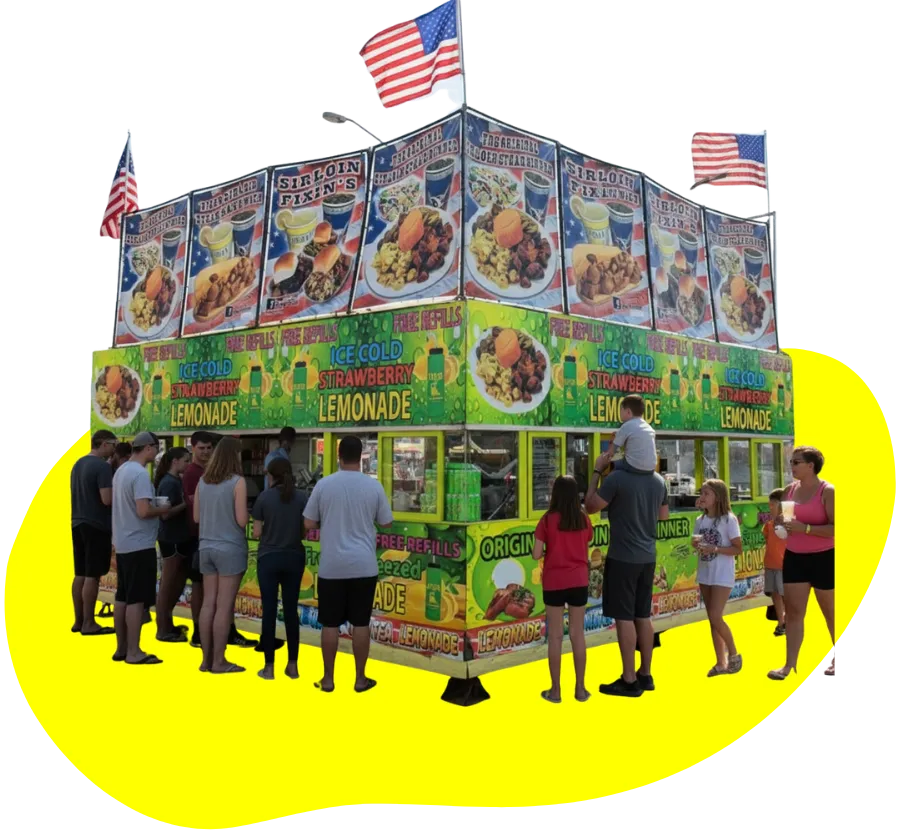
I've been in the mobile food business for nearly 20 years. I run 12 food concepts across 5 state fairs operating in 9 states. I've made every mistake in the book and figured out what actually works.
This guide covers everything you need to start a food truck business in 2026 — the real costs, the right licenses, the equipment you actually need, and how to find events that will make you money. No fluff. No theory. Just what works.
If you want to skip the learning curve and get direct coaching from someone who's in the booth every season, join The Concession Collective for free — our community of mobile food operators who share what's actually working.
What Is a Food Truck Business?
A food truck business is a mobile food operation that sells prepared food from a vehicle or trailer at events, markets, festivals, and fixed locations. Unlike a traditional restaurant, your kitchen is on wheels — which means lower startup costs, flexibility to go where the customers are, and the ability to test concepts without signing a long-term lease.
Food trucks operate in several formats:
- Traditional food trucks — self-contained vehicles with kitchen equipment built in
- Concession trailers — pulled behind a truck, more space, easier to customize
- Food booths — tent-based setups for fairs and festivals
- Carts — smaller operations for high-foot-traffic locations
Each has different startup costs, licensing requirements, and ideal venues. For a deep comparison, read our guide on food truck vs concession trailer vs food booth.
Step 1 — Choose Your Food Concept
Your concept is the foundation of everything. Before you buy a truck, sign a lease, or apply for a license, you need to know exactly what you're selling and who you're selling it to.
The best food truck concepts share three traits:
High margin. Your food cost should be 25-35% of your selling price. Items like lemonade, kettle corn, and specialty fries have food costs under 20%. Items like lobster rolls can eat 50% of your revenue. Know your numbers before you commit to a concept.
Simple to execute at volume. A festival line can have 200 people in it. If your menu takes 8 minutes per order, you will lose half those customers. The best food truck menus have 5-8 items that can be assembled in under 2 minutes each.
Differentiated. Every fair has a burger truck. What makes yours different? The operators making the most money are not selling the most common food — they are selling something people cannot get anywhere else at that event.
Spend time at local events before you start. Watch which trucks have the longest lines. Talk to operators. Eat the food. Notice what is missing. That gap is your opportunity.
Step 2 — Write a Simple Business Plan
You do not need a 40-page MBA business plan. You need a one-page document that answers five questions:
- What am I selling and to whom?
- Where will I operate (events, markets, fixed location)?
- What are my startup costs and where is the money coming from?
- What does my first year of revenue look like realistically?
- What does success look like at 12 months?
The purpose of a business plan is not to impress a bank. It is to force you to think through the numbers before you spend money. Most food truck failures happen because the operator never modeled what they actually needed to make to break even.
For detailed startup cost breakdowns, read our guide on concession stand startup costs.
Step 3 — Understand Your Startup Costs
Food truck startup costs vary widely depending on whether you buy new, used, or build a trailer from scratch. Here is a realistic range:
New food truck: $75,000 — $150,000+
Used food truck: $20,000 — $75,000
Custom concession trailer: $15,000 — $60,000
Used trailer with equipment: $8,000 — $25,000
On top of the vehicle, budget for:
- Commercial kitchen equipment: $5,000 — $30,000
- Licenses and permits: $500 — $5,000 depending on your state
- Initial food inventory: $1,000 — $5,000
- Commissary fees (if required): $300 — $800/month
- Insurance: $1,500 — $3,000/year
- POS system and payment processing: $500 — $2,000
- Branding, signage, and wraps: $2,000 — $8,000
- Working capital (3 months of expenses): Variable
Total realistic startup range: $30,000 — $100,000+
The operators who struggle financially are almost always the ones who underestimated startup costs and ran out of working capital before they could build a customer base.
Step 4 — Get Your Licenses and Permits
Licensing is the part most new operators dread — but it is more straightforward than people think. Here is what you typically need:
Business registration
Register your business entity (LLC is most common for food trucks) with your state. This protects your personal assets and is required before applying for most other licenses.
Food handler certification
Most states require the owner and at least one employee to hold a food handler or food manager certification. ServSafe is the most widely accepted certification nationally.
Mobile food unit permit
Issued by your local health department. They will inspect your truck or trailer to verify it meets sanitation and safety standards. This is typically renewed annually.
Sales tax permit
If your state collects sales tax on food (most do at events), you need a sales tax permit to collect and remit it.
Fire safety inspection
Required in most jurisdictions, especially if you are using propane or open flame equipment.
Event-specific permits
Many fairs, festivals, and markets require their own vendor applications and permits. These are separate from your city and county licenses.
Commissary agreement
Many states require food trucks to operate from a licensed commissary — a commercial kitchen where you prep food and clean equipment. Budget $300-800/month for commissary access.
Licensing requirements vary significantly by state and municipality. Always contact your local health department before you buy equipment. Find out exactly what they require before you spend money on a setup that does not comply.
Step 5 — Buy or Build Your Truck or Trailer
This is where most first-time operators overspend. Here is my honest advice after nearly 20 years:
Start with used or build a trailer. A new $150,000 food truck is a massive financial burden when you are still learning what events work for your concept, what your menu should look like, and how to manage a crew. A used trailer or truck in the $15,000-30,000 range gives you the same earning potential with much less financial risk.
Custom trailers built to your spec are often the best value. You get exactly the layout you need, with new equipment, at a fraction of the cost of a new truck. I have built custom concession trailers for under $25,000 that outperform trucks that cost five times as much.
Inspect used equipment carefully. Generator condition, propane systems, refrigeration units, and hood suppression systems are the most expensive things to repair or replace. Always have a mechanic inspect a used truck before you buy.
Key equipment every food truck needs:
- Commercial range or flat top grill (depending on concept)
- Commercial refrigeration (reach-in cooler, undercounter units)
- Commercial hood with fire suppression system
- Generator or shore power hookup
- Three-compartment sink and handwashing sink
- Food warmers or steam tables (if applicable)
- POS system for payment processing
For a complete equipment list, read our concession stand equipment guide. If you're considering a booth or tent setup instead of a truck, our how to start a concession stand guide covers that path step by step.
Step 6 — Choose Your Events and Venues
This is where most food truck businesses either win or lose. Location is everything in mobile food — and not all events are created equal.
The operators making serious money are not just showing up to every farmers market and street fair. They are strategic about which events they book and how they negotiate their deals.
State fairs and large festivals offer the highest revenue potential. A well-run booth at a major state fair can do $30,000 — $150,000+ in 10-14 days. But they are competitive to get into, require significant inventory and staffing, and have high upfront costs. For a step-by-step breakdown of the application process, read our guide on how to get approved for state fairs.
Farmers markets and weekly markets provide consistent, predictable income. Lower volume per day but more reliable than one-off events. Good for building a customer base and testing your menu.
Corporate catering and private events are high-margin opportunities. Guaranteed minimum revenue, captive audience, and often repeat business. Worth investing time to develop.
Brewery and winery partnerships have exploded in the last five years. Many breweries bring in rotating food trucks several nights per week. Lower volume but low overhead and a loyal customer base.
Street food and fixed locations work in high-foot-traffic areas but require city permits and often face competition from brick-and-mortar restaurants.
For a full breakdown of finding the best events for your concept, read our guide on how to find the best fairs and festivals for food vendors. If you are starting in Texas, see our state-specific guide on how to start a food truck business in Texas.
Step 7 — Price Your Menu for Profit
Most food truck operators price by feel — they charge what seems reasonable or what competitors charge. That is not a pricing strategy. That is a way to lose money slowly.
Price your menu using food cost percentage:
Your food cost should be 25-35% of your selling price.
If an item costs you $2.50 to make (ingredients only), the minimum selling price at 35% food cost is $7.14. At 25% food cost it is $10.00.
Then layer in your other costs:
- Labor cost per item
- Booth fee or event percentage allocated per item
- Packaging cost
- Overhead (insurance, commissary, vehicle costs) allocated per item
Your selling price needs to cover all of these costs plus a net profit margin. Most successful food truck operators target 20-35% net profit after all costs.
Do not compete on price. Competing on price in mobile food is a race to the bottom. Compete on quality, uniqueness, and experience. Customers at events expect to pay more than they would at a restaurant. Price accordingly.
For a deep dive on pricing strategy, read our guide on concession stand menu pricing strategy. We also have a free pricing calculator you can use to model your numbers before you commit to a menu.
Step 8 — Hire and Train Your Team
Most food truck operators try to do everything themselves in the beginning. That works for the first season. After that, it becomes the ceiling on your growth.
The operators scaling to multiple trucks and multiple events all have one thing in common: they built a system their team can run without them standing over every transaction.
Hire for reliability first, skills second. You can teach someone to make your food. You cannot teach someone to show up on time, work hard in a hot kitchen, and treat customers well. Hire character and train skill.
Document everything. Create simple one-page SOPs for every station in your truck. Setup, service, and breakdown should be documented so any trained team member can run any station.
Pay fairly and invest in your people. High turnover kills food truck operations. The events where things go wrong are almost always the events where you are short-staffed or running with untrained people. Pay above minimum wage, treat your team well, and you will build a core group that shows up and performs.
Step 9 — Market Your Food Truck
The best marketing for a food truck is great food and great service at events. Word of mouth and repeat customers at recurring events are your foundation.
Beyond that, the channels that actually move the needle:
Instagram and TikTok — visual food content performs extremely well on both platforms. Short videos of your food being prepared, your setup at a busy event, and behind-the-scenes content build a following that converts to customers.
Google Business Profile — when someone searches your truck name or food type plus your city, your GBP listing is what shows up. Set it up, keep it updated with your event schedule, and collect reviews consistently.
Email list — collect emails at every event. Send a monthly newsletter with your upcoming schedule. Your most loyal customers will follow you from event to event.
Event listing sites — list your truck on Roaming Hunger, Street Food Finder, and similar platforms. These drive discovery from people actively looking for food trucks in their area.
Step 10 — Plan for Growth
The first season is about survival — learning what works, fixing what does not, and building the systems and relationships that will support growth.
The operators who build real wealth in this industry do it by duplicating what works:
- Adding a second truck or trailer with the same proven concept
- Adding a second concept at the same events (more revenue from the same location)
- Expanding to more events as your operational capacity grows
- Building a franchise or licensing model around your concept
None of this is possible without the systems, documentation, and team you build in your first 1-2 seasons. The grind of season one is actually building the foundation for everything that comes after.
The Shortcut: Learn From People Who've Done It
The biggest mistake new food truck operators make is trying to figure everything out alone. There are people who have already made the mistakes, found the events that pay, built the menus that sell, and developed the systems that scale.
Learning from them is the fastest way to profitable operations.
The Concession Collective is a free community of mobile food operators — food truck owners, concession stand operators, and festival vendors — who share what is actually working. You get access to Module 1 of The Mobile Food Roadmap, guest coach recordings from active operators, and a community of people who are in the booth every season.
If you are serious about building a profitable food truck business, join free today. No credit card. No commitment. Just real information from people who are actually doing it.
For operators who want direct coaching, our programs range from group coaching to 1-on-1 work with Borjan. Compare all plans here.
For operators serious about accelerating their growth, learn about our Inner Circle program — our highest-tier coaching with only 5 spots.